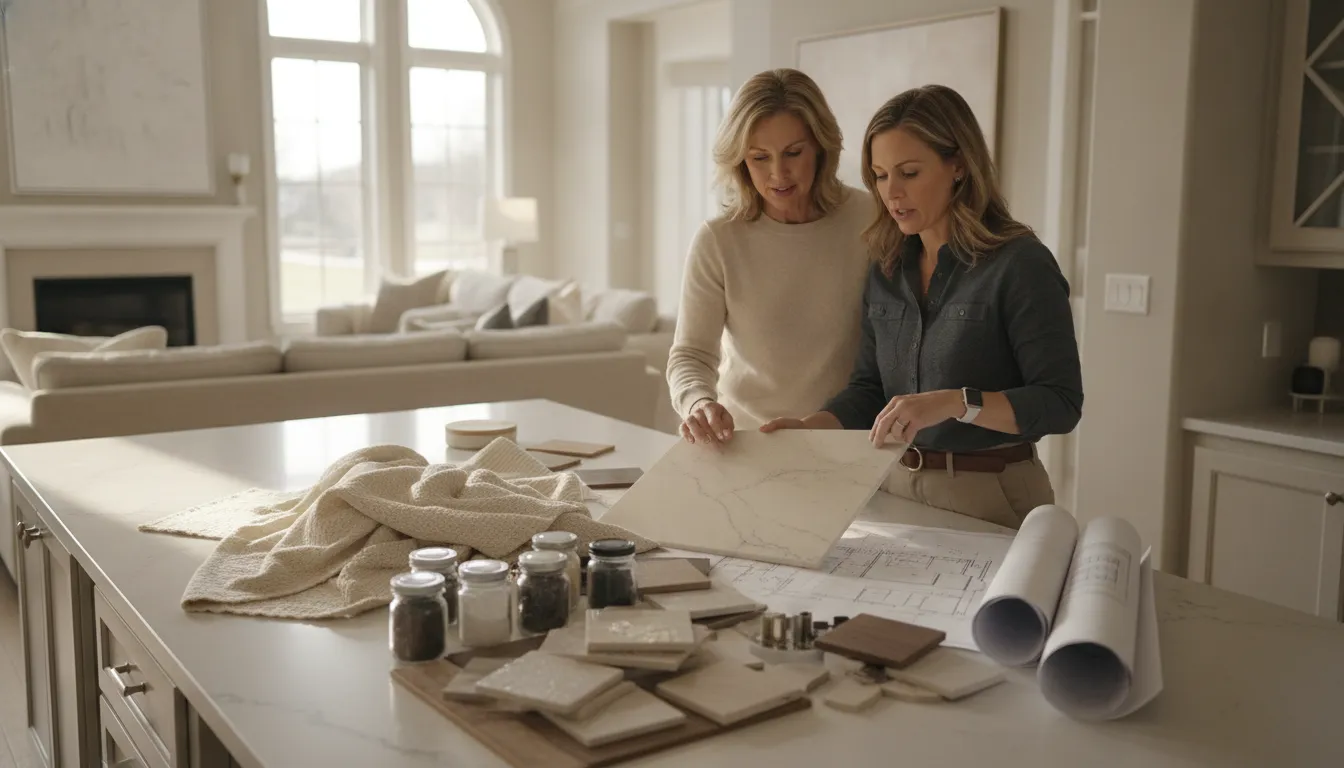
Answer: Compare a renovation contractor by checking experience, registration, insurance, written scope, contract terms, communication, and coordination. Confirm who owns the work from design through construction.
A renovation can look straightforward in photographs and still involve months of decisions, coordination, and disruption inside your home. For homeowners in West Des Moines and across the Des Moines metro, choosing the right partner means evaluating more than a polished portfolio. You need to understand who will manage design, selections, permits, construction, communication, and changes when the work becomes complex.
Schedule a Consultation to discuss your renovation ideas and map the decisions that should be resolved before construction.
The right home renovation contractor Des Moines homeowners choose should show relevant experience and explain credentials and insurance. The contractor should define the scope in writing and provide a transparent process with clear accountability from planning through completion.
This guide outlines the questions that help you compare contractors with greater confidence, from references and red flags to contract language and design-build coordination. As you consider how to plan a luxury Des Moines renovation, begin with why this decision shapes nearly every part of the experience that follows.
Why choosing a renovation contractor is one of the most important decisions you will make
A renovation changes more than a room. It can affect how your household moves through the home, where you cook, how you manage privacy, and how long daily routines remain disrupted. The contractor you choose must translate an idea into a workable scope, coordinate many moving parts, and remain accountable when conditions change. That responsibility matters whether you are updating a kitchen in West Des Moines or planning a larger whole-home renovation in the Des Moines metro.
Portfolio photos can show craftsmanship and design sensibility, but they cannot show how clearly a contractor defines the work before construction begins. The Iowa Attorney General recommends writing down the desired work and materials in as much detail as possible before requesting bids. This creates a shared starting point and helps reveal whether each contractor is pricing the same project. Review the state's home improvement and contractor tips as part of your due diligence. See the plan a luxury Des Moines renovation guide for more context on planning a substantial renovation.
Scope determines the quality of the comparison
A polished presentation is not a substitute for a complete written comparison. Iowa Attorney General guidance recommends getting several written estimates and confirming that each includes everything you want, without adding work you did not request. If one proposal includes design coordination, engineering, finish selections, demolition, temporary protections, and cleanup while another does not, the totals may look comparable even though the responsibilities are different. A meaningful comparison starts with aligned scope, materials, allowances, assumptions, and exclusions.
Ask each contractor to explain what is included, what remains undecided, and how changes will be documented. A clear answer is more valuable than a confident promise because it shows how the team manages uncertainty before it becomes an expensive surprise.
Coordination protects the experience of living through construction
During renovation, design decisions, ordering, inspections, subcontractors, site access, and sequencing all interact. A missed handoff can extend disruption or force a decision before you have enough information. Strong contractor accountability means someone owns those connections and communicates what is happening, what is needed from you, and what comes next. That visibility helps you evaluate not only the finished result, but also the discipline behind delivering it.
For a major investment, choose the team that can make the work understandable and coordinated, not simply the team with the most attractive gallery.
How to evaluate a home renovation contractor in Des Moines
A portfolio can show design sensibility, but it cannot answer every question that matters before work begins. When comparing a home renovation contractor in Des Moines, verify the business behind the photographs, the people who will be involved, and the systems that will protect your project. Iowa Attorney General guidance recommends requesting local references, checking complaints, comparing complete written estimates, and asking for proof of liability insurance. Review the state's home improvement and contractor tips as part of your due diligence.
Credentials and responsibility
Ask whether the contractor is registered with Iowa's Department of Inspections, Appeals, and Licensing (DIAL), when the registration was last renewed, and whether any trade-specific licenses apply to the work. Iowa generally requires qualifying construction contractors to register with the state, subject to stated exceptions. Plumbing, mechanical, HVAC, refrigeration, sheet metal, and hydronic services have additional licensing requirements. Review DIAL's contractor registration guidance for current requirements. Registration and bonding are useful verification points, but they do not guarantee workmanship or resolve every possible dispute.
Request a current certificate of liability insurance and ask who is responsible if property is damaged or someone is injured. If subcontractors will perform portions of the work, ask how their registration, insurance, and qualifications are verified. Iowa DIAL notes that subcontractors are not covered by a general contractor's registration, so this should be a specific conversation rather than an assumption.
Project experience and reputation
Request references for renovations similar in scale and complexity to yours, ideally in the Des Moines metro or a nearby community such as West Des Moines. Ask former clients about communication, site care, schedule changes, workmanship, and how disagreements were handled. Check complaints with the Iowa Attorney General and the Better Business Bureau, and read online reviews with a critical eye. A contractor should be willing to explain what it actually managed on a project, not simply point to finished photographs.
- Can you verify the contractor's Iowa registration, renewal status, and applicable trade licenses?
- Will the contractor provide current insurance documentation and identify responsibility for damage or injury?
- Are each of the proposed subcontractors properly registered and qualified for their work?
- Can you contact local references for comparable renovations and review complaints independently?
- Do multiple written estimates describe the same complete scope, materials, exclusions, and responsibilities?
| Evaluation area | Question to ask | What a clear answer shows |
|---|---|---|
| Credentials | Can you verify registration, insurance, and trade qualifications? | The contractor is willing to document responsibility and compliance. |
| Scope | What is included, excluded, or still undecided? | The estimate can be compared on an informed basis. |
| Coordination | Who owns design, selections, permits, and site communication? | Important handoffs have a named point of accountability. |
| Contract | How are dates, payments, warranties, and changes recorded? | The working relationship is defined before construction starts. |
The cheapest estimate is not necessarily the best choice. If bids differ substantially, ask what scope, materials, allowances, or responsibilities explain the gap. Clear answers are more valuable than a low number that leaves important decisions unresolved.
What does design-build change about a renovation?
In a traditional renovation arrangement, the homeowner may coordinate an architect, interior designer, general contractor, and several specialty partners separately. That can create more conversations to manage and more opportunities for an important decision to be interpreted differently as it moves from one party to the next. A design-build model brings architecture, interior design, and construction together under one coordinated team.
That structure changes accountability first. Instead of asking which professional owns a missed detail, the homeowner has a clearer point of responsibility for the relationship between the design and the work. The team can evaluate how a layout, material selection, structural condition, or construction method affects the others before the project reaches the job site. For a substantial renovation in West Des Moines or elsewhere in the Des Moines metro, that coordination can make the planning experience easier to understand and more deliberate.
It also gives decisions a more useful context. A designer can consider the way a room will be built, while the construction team can identify practical implications before a selection becomes difficult or expensive to change. Budget conversations are connected to scope, engineering, selections, and existing conditions rather than treated as a separate exercise. This does not remove the variables that come with renovating an existing home, but it can make those variables visible earlier.
Schedule a Consultation to discuss your renovation ideas and map the decisions that need to be resolved first.
Where the process becomes clearer
Axiom Design-Build describes this approach through the Axiom Method. Its five phases include Discovery, Architectural Strategy, Project Resolution, Precision Construction, and Legacy Delivery. The important differentiator for renovation planning is Project Resolution, where selections, engineering, and pricing are addressed before construction begins. That gives the homeowner a defined point at which major decisions are brought together. Rather than leaving the job site to serve as the place where unresolved design questions are settled.
The result is not a promise that every project will be simple or perfectly predictable. It is a more unified way to move from an initial idea toward construction, with clearer updates, transparent budgeting, and one team responsible for keeping the work aligned. Learn more about what an integrated design-build construction team can change in a renovation before comparing proposals.
Red flags to watch for when interviewing renovation contractors
A renovation bid deserves more scrutiny than a quick comparison of bottom-line numbers. An unusually low estimate may reflect missing scope, lower-grade materials, or assumptions about workmanship that have not been discussed. Iowa Attorney General guidance recommends asking whether a low bidder is qualified for the work and whether the price depends on cutting corners. The cheapest option is not necessarily the best choice. Compare complete written estimates and ask contractors to explain any major differences rather than rewarding the lowest figure automatically.
Pressure is another warning sign. Be cautious about "today only" pricing, urgent claims, or requests to sign before you can compare options. A reputable home renovation contractor in Des Moines should be willing to explain the scope, answer questions, and give you reasonable time to review the proposal. If financing is offered, ask for the complete terms and do not sign a loan or payment plan you do not understand.
Questions that expose unclear estimates
- What work and materials are included, and what is specifically excluded?
- Which allowances or assumptions could change the final scope?
- Who will obtain permits, schedule inspections, and coordinate required trades?
- How will changes be documented, priced, and approved?
Be especially careful with demands for all payment upfront, cash-only payment, or payment without receipts. The Federal Trade Commission identifies those practices as scam warning signs and recommends traceable payments. You should also expect a clear conversation about permits and inspections. Avoiding the subject, or insisting permits are unnecessary without an explanation, warrants further investigation. Ask for proof of liability insurance and clarify who is responsible if property is damaged or someone is injured.
Finally, treat weak documentation and polished but vague reviews as reasons to slow down, not as proof of misconduct. Request a written estimate, contract, contact information, license or registration details, schedule assumptions, and specific material descriptions. Read online reviews critically, then ask for relevant local references you can contact. Clear answers and organized records create the clarity you need before construction begins.
Questions to ask before signing a renovation contract
A renovation contract should turn a shared understanding into a specific, reviewable plan. Before signing with a home renovation contractor in Des Moines, compare the document with your intended scope and ask what is included, excluded, assumed, or still undecided. Iowa Attorney General guidance recommends a written agreement covering the work, materials, price, permits, inspections, schedule, change orders, and cleanup. Review the state's contractor tips alongside your contractor's proposal.
- Scope and materials: Does the contract describe every room, task, finish, fixture, and allowance clearly enough to distinguish the promised work from optional work? Are brands, product specifications, quantities, and installation standards identified? A written estimate should describe the work and materials, not rely on verbal assumptions. The FTC also recommends documenting the scope, materials, dates, and price.
- Price and allowances: What is the contract price, what is an allowance, and what happens if a selected product costs more or less than the allowance? Does the proposal include labor, delivery, disposal, design, engineering, and other project costs that apply to your scope? If estimates differ substantially, ask each contractor to explain the difference rather than choosing by headline price alone.
- Permits and inspections: Who obtains each required permit, schedules inspections, pays the associated fees, and responds to corrections? The contract should name the responsible party. Confirm the answer with the relevant city or county instead of assuming the contractor will handle every approval.
- Schedule: What are the anticipated start and completion dates, and what events could change them? How will delays, long-lead materials, weather, or owner decisions be documented? Put dates and any agreed remedies in writing, not only in a conversation.
- Written change orders: Will every change identify the revised scope, price, material impact, and schedule effect before the work proceeds? Require written approval for changes so an evolving renovation does not become a series of disputed assumptions.
- Cleanup and protection: Who protects occupied areas, controls dust, removes debris, and completes final cleanup? Define the expected condition of the home at each milestone and at handoff.
- Payment: What is the payment schedule, what milestone supports each payment, and how are receipts provided? Use traceable payments, avoid paying the full amount before work is complete, and do not accept financing terms you do not understand.
- Communication: Who is your day-to-day contact, how often will updates occur, and where will decisions be recorded? Include response expectations and the process for resolving questions.
- Warranty and responsibility: What workmanship or product warranties apply, how are claims submitted, and who coordinates the response? Also ask who is responsible if property is damaged or someone is injured, and request proof of applicable insurance.
- Accountability: Who is responsible for the contractor's employees, subcontractors, design decisions, selections, permits, and final coordination? The contract should identify the contractor's legal name, address, phone number, license or registration information, and the promises made during discussions. These questions are practical planning steps, not legal advice. Consider having an attorney review the agreement when the project or terms warrant it.
Clear answers before construction create a stronger basis for decisions later. If an important answer remains verbal, ask for it to be added to the contract or its attachments before you sign.
Why process transparency matters as much as portfolio quality
Beautiful project photography shows what a renovation can become. It does not show how decisions were made, what the scope includes, or how the team responds when an existing condition changes the plan. For a major renovation in West Des Moines or elsewhere in the Des Moines metro, those details shape the experience as much as the finished kitchen, addition, or whole-home transformation.
Ask a prospective contractor how you will see the project develop before construction begins. Can the team explain which selections, engineering questions, and scope decisions must be resolved first? Are allowances and exclusions documented in language you can understand? How often will you receive updates, and who is responsible for communicating changes? A polished portfolio is evidence of design and craft. Clear answers to these questions are evidence of an operating process.
Visibility turns uncertainty into decisions
Axiom Design-Build calls this principle "Clarity Before Construction." Within the Axiom Method, the Project Resolution phase addresses selections, engineering, and pricing before construction starts. That does not mean every renovation has a universal price or an effortless schedule. It means the team works to make the assumptions behind the project visible, so homeowners can make informed decisions before work is underway.
That visibility should continue during construction through transparent budgeting, disciplined project management, and proactive updates. When architecture, interior design, and construction operate as one coordinated team, accountability has a clear home rather than moving between separate parties. The value is not simply fewer emails or attractive presentation materials. It is a more understandable path from an initial concept to an active job site.
Before choosing a home renovation contractor in Des Moines, look for a process that lets you resolve renovation decisions before construction. The right questions may reveal more about the partnership ahead than another gallery of finished rooms.
Finding the right renovation contractor in the Des Moines metro
Local familiarity matters when you are choosing a renovation partner for a home in West Des Moines or another Des Moines metro community. A contractor should understand the character of existing homes, coordinate with local requirements, and recognize how an addition, whole-home renovation, or major kitchen project will affect the way your household lives during construction. Ask how the team evaluates existing conditions and how early design, engineering, selections, and construction planning are brought together.
Look beyond polished portfolio photographs. Request references for work that resembles your project in scale, age, complexity, or design direction. A relevant example can reveal how the contractor handled structural changes, preserved meaningful details, coordinated trades, and communicated when decisions changed. For a sense of how a substantial renovation can balance character with updated function, see a Des Moines home renovation at Park Life. The documented project involved a full-scale renovation of a 4,970-square-foot home in the Greenwood-Ashworth Park neighborhood, including a reworked floor plan and restoration work.
Consider who will actually guide the work after the contract is signed. You should be able to identify the people responsible for design decisions, selections, scheduling. Site coordination, and communication, rather than meeting one person during sales and an unfamiliar team later. Ask how often you will receive updates, where decisions are recorded, and who owns the answer when architecture, interiors, and construction intersect. A coordinated team can reduce the gaps that arise when responsibilities are divided among separate firms.
Finally, arrive at the consultation ready to discuss your home's location, goals, constraints, and rough ideas. The strongest conversations are specific without requiring a finished plan. Whether you are in West Des Moines, Johnston, Waukee, Urbandale, Ankeny, or nearby. Look for a contractor who asks disciplined questions, explains the next step clearly, and earns trust before construction begins. Those signals provide a useful bridge into the questions worth asking before you choose.
Schedule a Consultation to bring your renovation ideas to a team that can clarify scope, design, and next steps before construction.
Frequently Asked Questions
What should I verify before hiring a renovation contractor in Des Moines?
Verify relevant local references, contractor registration or trade licensing where applicable, liability insurance, and responsibility for permits and inspections. Iowa guidance also recommends checking complaint records and contacting references directly. Registration or bonding alone does not guarantee workmanship or resolve every dispute, so review the contractor's process and documentation as well.
How should I compare renovation bids?
Compare written estimates that cover the same scope, materials, allowances, schedule assumptions, and exclusions. A substantially lower bid deserves an explanation, because it may reflect omitted work or different materials rather than a better value. The Iowa Attorney General recommends getting several written estimates and notes that the cheapest price is not always the best choice.
What should a renovation contract include?
Look for a clear description of the work, material specifications, price, payment schedule, estimated start and completion dates, permit responsibilities, cleanup, warranty terms, and a written change-order process. Confirm that promises made during meetings are reflected in the contract before signing.
How does a design-build renovation process work?
Design-build brings design and construction coordination into one accountable team instead of separating them between unrelated firms. Axiom's process uses Discovery, Architectural Strategy, Project Resolution, Precision Construction, and Legacy Delivery, with selections, engineering, and pricing addressed before construction begins.
How do I begin planning a renovation?
Start by defining the spaces, priorities, and problems you want the project to address, then gather questions and rough ideas for an initial conversation. A consultation can help clarify scope, process, and next steps before you compare proposals or commit to a contractor.
Ready to plan your renovation with clarity?
Choosing a renovation contractor is easier when the conversation begins with your goals, the home's needs, and the decisions that should be resolved before construction. Axiom Design-Build brings architecture, interior design, and construction into one coordinated process, giving homeowners a clearer path from early ideas to next steps.
Schedule a Consultation to discuss your renovation goals. Rough concepts are welcome, and the conversation can help shape the right starting point for your Des Moines-area project.